
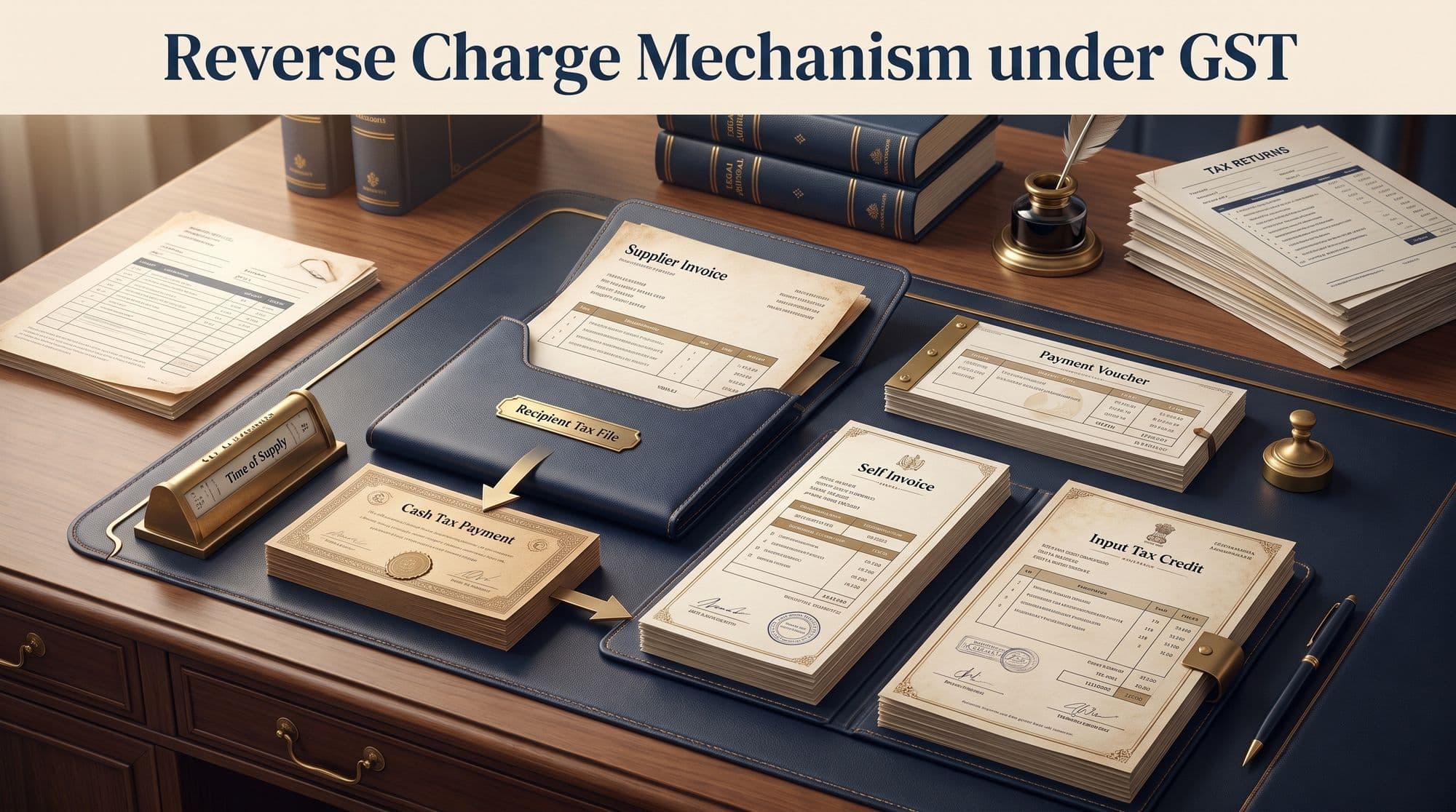
Under the normal charge, the supplier collects tax from the recipient and pays it to the Government. Reverse charge inverts this. The recipient becomes the person liable to pay tax, and the supplier issues an invoice without charging it.
The mechanism exists mainly where the supplier base is difficult to administer, or where the supplier is outside the tax net. It is straightforward in principle and untidy in practice, because the compliance obligations sit with the party that did not raise the invoice.
The two routes
Liability under reverse charge arises through one of two provisions.
Section 9(3) covers categories of supply notified by the Government. Goods transport agency services, legal services from an advocate, sponsorship, services from a director in a personal capacity, and import of services are among the familiar entries. The nature of the supply determines the liability.
Section 9(4) covers supplies from an unregistered supplier to a specified class of registered recipients. Its scope is narrower than it was in the early years and now operates for notified categories.
Time of supply
The time of supply under reverse charge is different from the normal charge, and this decides the month in which the liability is reported.
Supply | Time of supply is the earliest of |
|---|---|
Goods | Date of receipt of goods, date of payment as entered in the books or debited in the bank account, or the date immediately following thirty days from the date of the invoice |
Services | Date of payment as entered in the books or debited in the bank account, or the date immediately following sixty days from the date of the invoice |
Associated enterprises outside India | Date of entry in the books of the recipient, or the date of payment, whichever is earlier |
Where none of these can be determined, the date of entry in the books of the recipient applies. The sixty day rule for services is the one most often missed, because an unpaid invoice continues to create a liability regardless of the payment status.
Payment has to be in cash
Tax under reverse charge cannot be discharged by using input tax credit. It has to be paid in cash through the electronic cash ledger. The credit of that tax is then available in the same or a later month, subject to the usual conditions. This creates a real cash flow effect that should be planned for, particularly where import of services is regular.
Self invoicing and the payment voucher
Where a registered person receives a supply from an unregistered supplier and pays tax under reverse charge, section 31(3)(f) requires the recipient to issue an invoice in respect of that supply. A payment voucher must also be issued at the time of making payment.
This is a documentation requirement that is frequently ignored, and its absence becomes an easy finding in audit. The self invoice should carry the same particulars as a normal tax invoice, with the reverse charge position stated on its face.
Reporting in the returns
The reporting is split across the returns and needs to be consistent.
Inward supplies liable to reverse charge are reported in the relevant table of GSTR-3B, and the tax is paid in cash.
The corresponding credit, where admissible, is claimed in the input tax credit table of the same or a later GSTR-3B.
The annual return requires a reconciliation of the reverse charge liability declared and paid.
Where errors usually appear
Legal services received from an advocate treated as exempt rather than as a reverse charge supply
Goods transport agency freight recorded as a plain expense without any tax entry
Director sitting fees and similar payments left out of the reverse charge working
Import of services identified only at the year end, creating an interest exposure for earlier months
Credit of reverse charge tax claimed in the month of the invoice rather than the month in which the tax was paid