
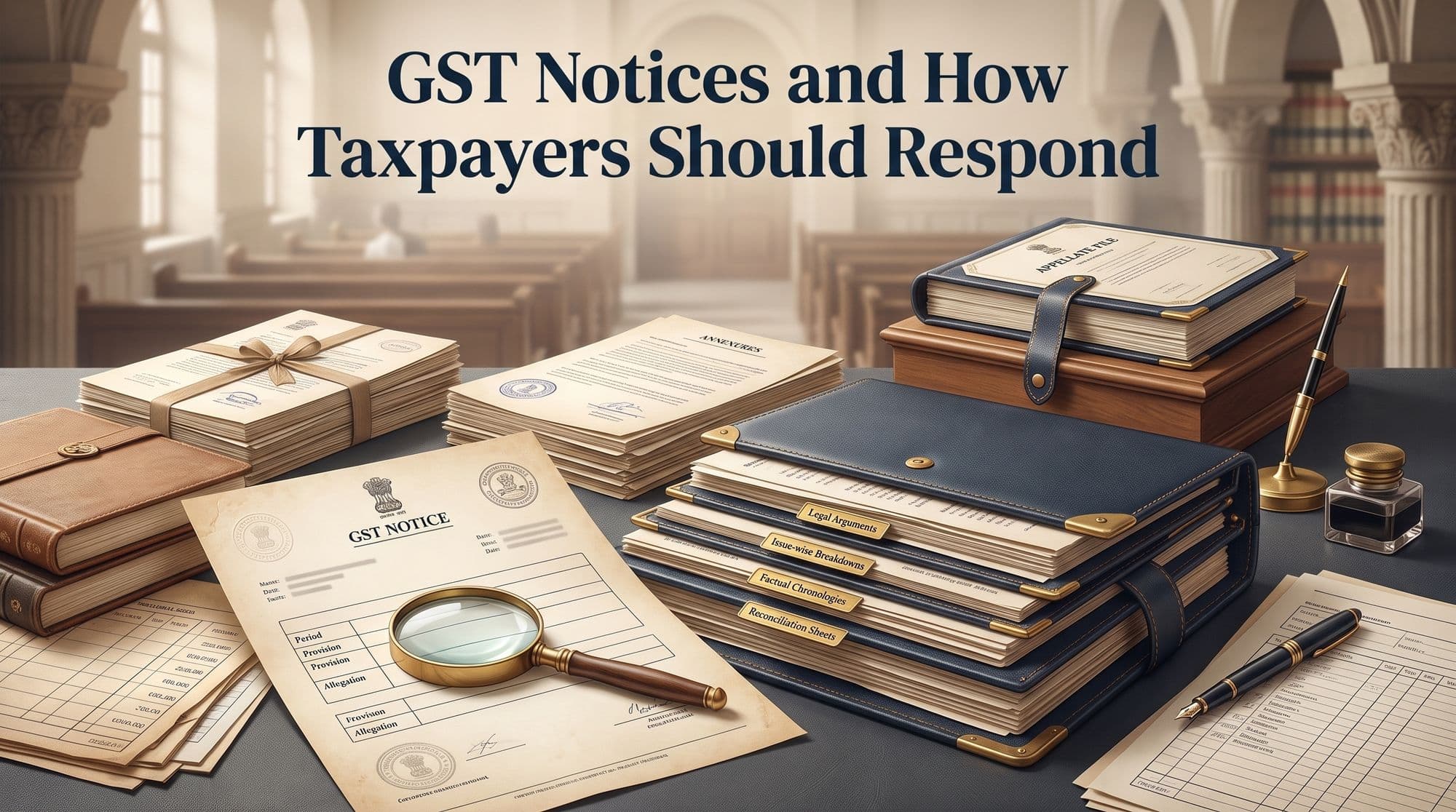
A notice under GST is not merely a request for information. It opens a record. Everything said in the reply, and everything not said, will be read again by the appellate authority and, if the matter travels further, by the tribunal or the court. A reply drafted for the immediate officer alone is often the reason a good case becomes difficult later.
The main categories of notice
It is worth being precise about which provision a communication is issued under, because the consequences differ.
Form | Provision | What it means |
|---|---|---|
ASMT-10 | Section 61, scrutiny of returns | Discrepancy noticed in a return. A reply is expected in ASMT-11. |
DRC-01A | Rule 142(1A) | Intimation of liability before a formal show cause notice. An opportunity to pay or explain. |
DRC-01 | Section 73 or 74 | Formal show cause notice proposing demand of tax, interest and penalty. |
ADT-01 | Section 65 | Notice of audit by the tax authorities. |
REG-17 | Section 29 | Show cause notice proposing cancellation of registration. |
RFD-08 | Section 54 | Show cause notice proposing rejection of a refund claim. |
Reading the notice properly
Before any drafting begins, extract the following from the notice and put them on one sheet.
The period covered, and whether any part of it is beyond the limitation available under the provision invoked.
The provision under which it is issued, and the penalty that follows from it.
The exact allegation, separated issue by issue rather than treated as one demand.
The basis of computation, and whether the figures reconcile with the returns and the books.
The documents relied upon, and whether copies of all of them have been supplied.
The date of the reply and the date of personal hearing, if fixed.
It is common for a single notice to bundle several unconnected issues. Answering them as a block produces a weak reply. Answering each separately, with its own facts and its own legal position, produces a record that an appellate authority can work with.
Structuring the reply
A reply that holds up tends to follow the same structure.
Facts, stated plainly and in chronological order, without argument.
Issue wise response, each dealing with one allegation.
Legal position, with the statutory provision quoted and the relevant circular or notification identified.
Reconciliation, where figures are in dispute, presented as a working that ties the notice figure to the books figure.
Documents, listed and indexed, with each document referenced in the body of the reply.
Prayer, stating clearly what the taxpayer asks the officer to do.
The reply is the first draft of the appeal. Anything omitted at this stage will have to be explained later.
Points that are frequently lost by silence
Certain grounds have to be taken early. If they are not raised in the reply, taking them for the first time in appeal invites the question of why they were not raised before.
Limitation, where the period covered by the notice is beyond the time allowed
Absence of jurisdiction, where the notice is issued by an authority other than the proper officer
Failure to supply relied upon documents
Denial of an effective opportunity of hearing
The demand being based on a mechanical comparison of returns without examining the underlying records
Personal hearing
Section 75(4) requires that an opportunity of hearing be granted where a request is received in writing, or where an adverse decision is contemplated. A request for hearing should therefore be made expressly in the reply, not assumed.
Where a hearing is attended, file a short written submission on the same day recording what was argued. Oral submissions that do not appear on the record are difficult to rely on later.
After the order
If an adverse order is passed, note the date of communication carefully. The appeal period runs from that date and the pre deposit has to be arranged within it. A late appeal, even by a few days, adds a preliminary hurdle that could have been avoided by diarising the date when the order was received.