
Many commercial arrangements involve more than one supply for a single price. A contract may cover goods along with installation, or a package may include several products sold together. GST asks a preliminary question in every such case. Is this one supply or several?
The two definitions
A composite supply consists of two or more taxable supplies of goods or services, or any combination of them, which are naturally bundled and supplied in conjunction with each other in the ordinary course of business, one of which is a principal supply.
A mixed supply consists of two or more individual supplies made in conjunction with each other for a single price, where the combination does not constitute a composite supply.
How each is taxed
Type | Treatment under section 8 | Effect |
|---|---|---|
Composite supply | Treated as a supply of the principal supply | The rate and classification of the principal supply applies to the whole consideration |
Mixed supply | Treated as a supply of that item which attracts the highest rate of tax | The highest rate among the components applies to the whole consideration |
The natural bundling test
Whether supplies are naturally bundled is judged by the ordinary course of business rather than by the wording of the contract. The following indicators are usually considered.
Recipients ordinarily expect the elements to be supplied together
The elements are advertised as a package
A single price is charged and the components are not separately available in the normal course
One element is clearly dominant and the others exist to enable its enjoyment
The practice in that line of business treats the combination as one service
Applying the tests
Goods with transport and insurance
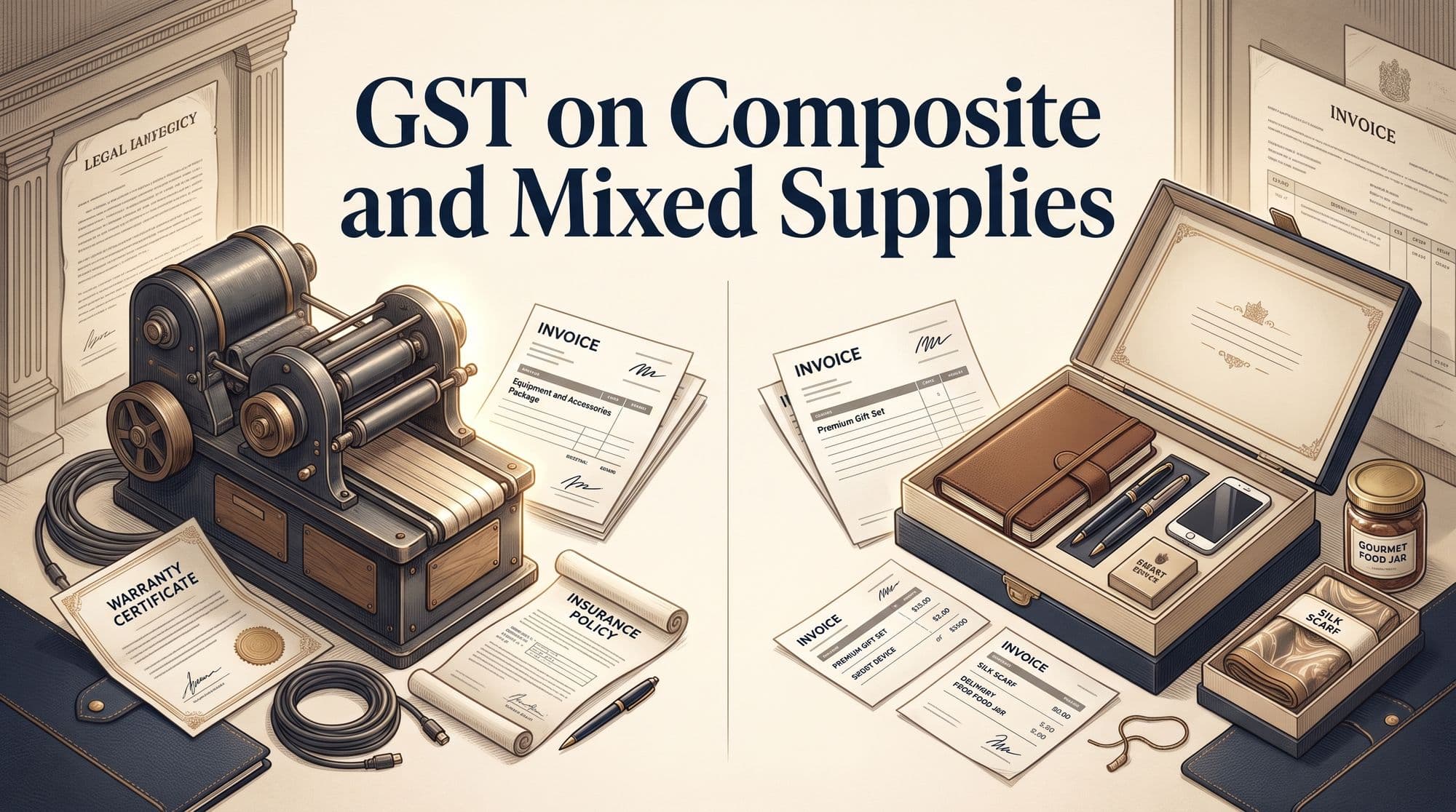
Where goods are supplied and the supplier arranges transport and insurance to deliver them, the transport and insurance ordinarily exist to enable the supply of goods. The combination is a composite supply with the goods as the principal supply.
Equipment with a warranty and maintenance
A warranty that is part of the sale and is not separately priced usually forms part of the supply of the equipment. A maintenance contract negotiated separately, priced separately and capable of being declined is a separate supply, and treating it as part of the goods is difficult to sustain.
A gift pack of assorted items
A pack containing items that are each independently available, sold together for a single price during a festival season, is a mixed supply. The highest rate among the items applies to the whole pack.
Practical points for documentation
State the components and their pricing clearly in the contract rather than leaving the composition to be inferred.
Keep the commercial rationale on record where components are bundled, since the natural bundling test looks at business practice.
Apply the classification consistently across contracts. An inconsistent position across similar contracts is an easy point for an officer to raise.
Where a single contract genuinely covers separate supplies, invoice them separately from the outset.