
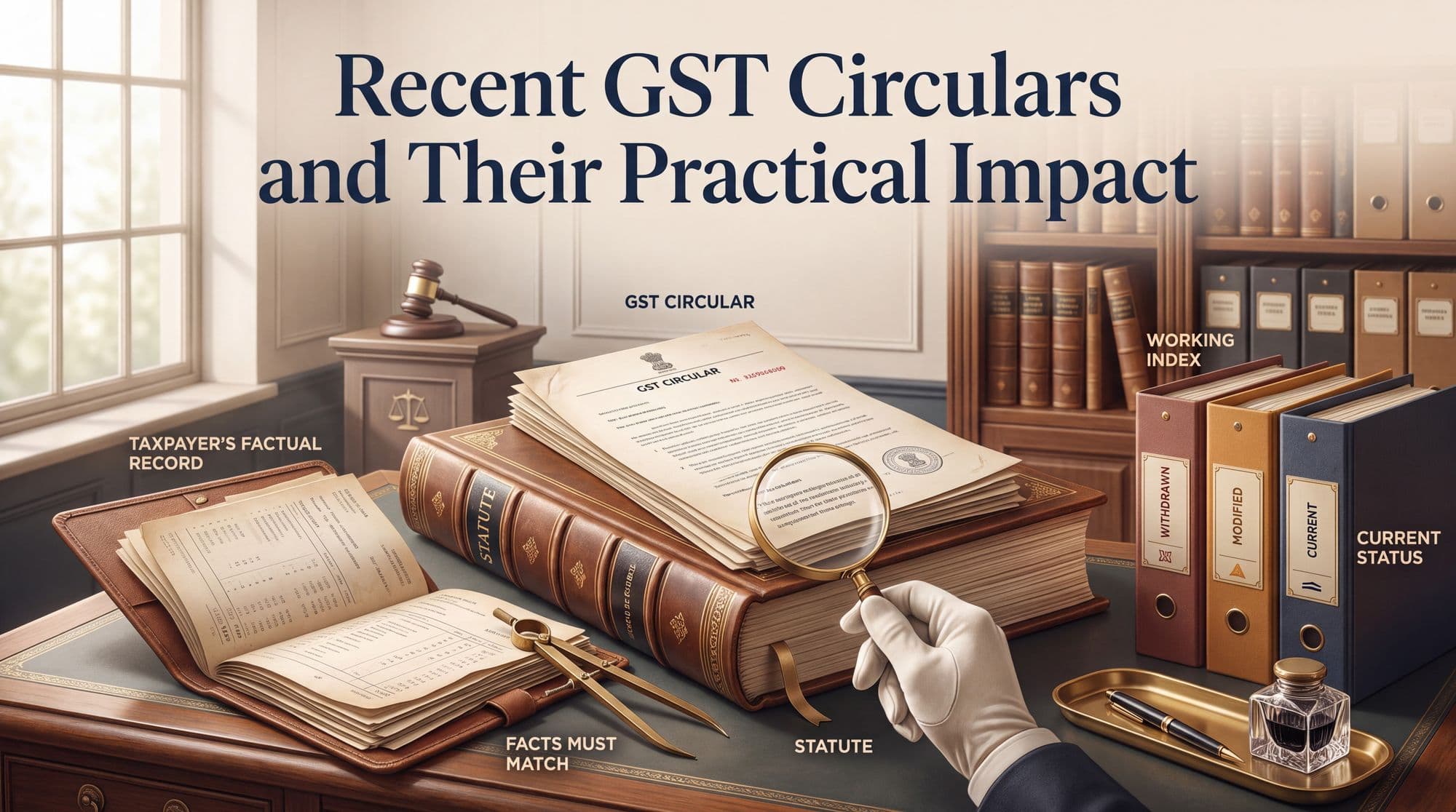
Circulars occupy an unusual position in tax practice. They are not law, yet they often decide how a matter is treated at the assessment stage. Understanding what a circular can do, and what it cannot, is necessary before relying on one.
The legal status of a circular
Circulars are issued under section 168 for the purpose of uniformity in implementation. They bind the officers of the department. They do not bind the taxpayer, and they cannot bind the courts.
A circular cannot override the statute. Where a circular takes a view contrary to the Act, the Act prevails.
A circular cannot create a levy or a restriction that the statute does not contain, since tax can be levied only by authority of law.
A beneficial circular can be relied on by a taxpayer against the department, because the department is bound by its own instructions.
A circular cannot be used against a taxpayer to deny a benefit that the statute allows.
Reading a circular
Circulars usually follow a pattern, and reading them in a fixed order avoids the common mistakes.
Identify the issue that was referred, since a circular answers a specific question and not a general subject.
Note the provisions it interprets, because a later amendment to those provisions may have overtaken it.
Note the date and the period to which it applies, and whether it is expressed to be clarificatory.
Read the illustrations carefully, as they usually define the boundary of the clarification.
Check whether it has been withdrawn, modified or superseded by a later circular.
The recurring subjects
Clarifications tend to cluster around the same areas, because these are where the statute leaves room for differing readings.
Subject | Why clarification is needed |
|---|---|
Place of supply in cross border and intermediary services | The tests are fact sensitive and the consequences differ sharply |
Valuation between related and distinct persons | The open market value concept requires practical guidance |
Input tax credit in specific commercial situations | The statute states principles rather than transaction level rules |
Refunds, including inverted duty and zero rated supplies | The computation formulas need worked application |
Procedural relaxations and time limits | Transitional and system related issues require administrative direction |
Using a circular in a reply
A circular is most effective when it is used precisely.
Quote the relevant paragraph rather than the circular as a whole
Show that the facts match the situation the circular addresses
State that the circular is binding on the officer under section 168
Where the circular is against the taxpayer, deal with it directly and explain why the statute governs, rather than ignoring it
A clarification is only as good as the facts it was issued for. Matching the facts is the whole of the exercise.