

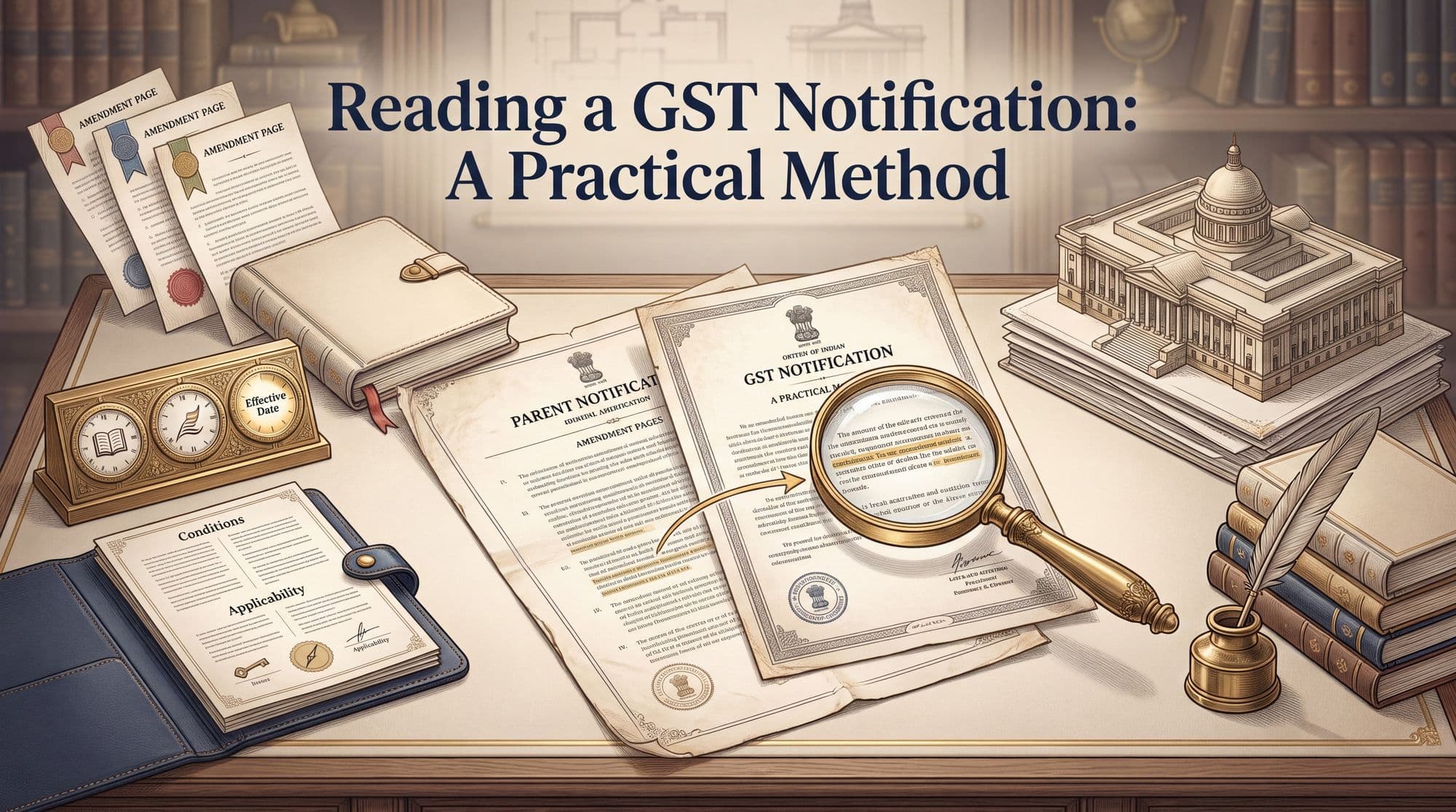
Most businesses learn about a notification through a summary. Summaries are useful for awareness and unreliable for action. Before a rate is changed in a master or a position is altered, the notification itself has to be read.
Identify the type
The first step is to see which power the notification is issued under, because that determines what it can do.
Rate notifications issued under section 9, which fix or change the rate of tax on specified supplies
Exemption notifications issued under section 11, which exempt supplies wholly or partly, often with conditions
Rules notifications issued under section 164, which amend the rules
Procedural notifications, which extend due dates, prescribe forms or notify classes of persons
Central tax, integrated tax and state tax notifications are issued separately. Confirming that the corresponding state notification exists matters where a state levy is involved.
Find the operative change
An amending notification usually reads as a set of instructions to substitute, insert or omit words in an earlier notification. It cannot be understood on its own.
Open the parent notification that is being amended.
Apply each instruction to the parent text, marking the change.
Read the amended entry in full, not just the amended words.
Check the explanations and conditions attached to the entry, since these carry most of the practical effect.
Establish the effective date
Three dates need to be distinguished and they are often different.
Date | What it means |
|---|---|
Date of the notification | The date it is signed and numbered |
Date of publication in the Gazette | The date it becomes publicly notified |
Date stated as the effective date | The date from which the change operates, which may be later or, where the power allows, earlier |
Where a notification is silent, it ordinarily takes effect from the date of publication. A change applied from the wrong date creates either a short payment or an excess payment, and both require correction.
Work out who is covered
Many notifications apply to a defined class, such as persons above a turnover threshold, or suppliers of a specified description. Read the applicability clause before assuming that a change is general.
Then decide the action
Record the change in the internal change log with the effective date.
Identify the transactions affected and the systems that need updating.
Where a rate changes, apply the time of supply rules to decide the correct treatment for transactions straddling the date.
Where an exemption is withdrawn, review contracts that were priced on the earlier basis.